
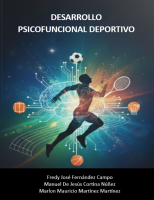
Desarrollo psicofuncional deportivo
Keywords:
1. Desarrollo psicofuncional 2. Psicología deportiva 3. Ciencias aplicadas 4. Sistema de ejerciciosSynopsis
En la historia reciente de las ciencias del deporte, hemos sido testigos de un cambio de paradigma sin precedentes. Durante décadas, el rendimiento atlético fue diseccionado en compartimentos estancos: por un lado, la biomecánica y la fisiología se encargaban del "hardware" del cuerpo; por otro, la psicología deportiva se ocupaba del "software" emocional. Sin embargo, esta división cartesiana ha demostrado ser insuficiente para explicar la complejidad del ser humano en movimiento.
El libro que el lector tiene en sus manos no es simplemente una recopilación de datos; es una revisión sistemática rigurosa que propone un lenguaje común bajo el concepto del Desarrollo Psicofuncional. Este término no es caprichoso: representa la simbiosis perfecta entre los procesos cognitivos superiores y la ejecución motriz eficiente. La presente obra surge de la necesidad imperativa de organizar el vasto cuerpo de literatura científica actual para ofrecer respuestas claras a entrenadores, rehabilitadores, psicólogos y científicos del deporte.
En la era de la infoxicación, donde se publican miles de artículos científicos al mes, el profesional corre el riesgo de perderse en el ruido. La revisión sistemática se erige aquí como un faro de objetividad. Los autores han realizado un esfuerzo titánico de cribado, análisis y síntesis, aplicando criterios de exclusión e inclusión que garantizan que las conclusiones aquí presentadas no se basen en anécdotas o modas pasajeras, sino en evidencia robusta.
Este libro analiza cómo las funciones ejecutivas de la inhibición, la memoria de trabajo y la flexibilidad cognitiva— no solo ocurren en el cerebro, sino que se manifiestan en cada zancada, en cada finta y en cada toma de decisiones bajo fatiga. Al consolidar estudios de diversos contextos geográficos y disciplinas deportivas, esta obra logra identificar patrones universales en el desarrollo psicofuncional que antes estaban dispersos.
A lo largo de sus capítulos, el texto desglosa tres dimensiones críticas que definen el éxito deportivo moderno:
La Plasticidad Funcional: Cómo el entrenamiento físico específico remodela no solo los músculos, sino las redes neuronales que gestionan el control motor. La Autorregulación bajo Estrés: El análisis de cómo el sistema nervioso autónomo y la corteza prefrontal interactúan para mantener la precisión técnica cuando el cortisol y la fatiga muscular amenazan el rendimiento. El Ciclo de Vida del Deportista: Un enfoque evolutivo que examina desde la base motriz en la infancia hasta el refinamiento cognitivo en la alta competición de élite.
La integración de estos pilares permite al lector comprender que un "error técnico" rara vez es puramente mecánico; a menudo es el colapso de una cadena psicofuncional donde la percepción del estímulo o la velocidad de procesamiento fallaron milisegundos antes del movimiento.
Más allá del rigor académico, esta obra tiene una vocación profundamente práctica. No se limita a decir "qué" sucede, sino que explora el "cómo" aplicar este conocimiento en el campo. Los profesionales encontrarán aquí las bases para diseñar protocolos de entrenamiento que desafíen simultáneamente el sistema metabólico y el sistema cognitivo, preparando al atleta para la realidad del caos competitivo.
Es un honor presentar una obra que no teme cuestionar dogmas establecidos y que invita a la reflexión crítica. El desarrollo psicofuncional es, en última instancia, el estudio de la excelencia humana. Este libro es el mapa esencial para navegar esa frontera donde la voluntad del espíritu se convierte en la potencia del cuerpo.
Invito al lector a sumergirse en estas páginas con curiosidad científica y ambición profesional. El futuro del entrenamiento deportivo no está en entrenar más, sino en entrenar de forma más integrada y fundamentada.
Chapters
-
CAPÍTULO 1 FUNDAMENTOS DEL DESARROLLO PSICOFUNCIONAL EN EL DEPORTE
Downloads
References
REFERENCIAS DEL CAPÍTULO 1
Ayranci, M., & Aydin, M. K. (2025). The complex interplay between psychological factors and sports performance: A systematic review and meta-analysis. PLOS ONE. https://journals.plos.org/plosone/article?id=10.1371/journal.pone.0330862
Ayranci, M., & Aydin, M. K. (2025). The complex interplay between psychological factors and sports performance: A systematic review and meta-analysis. PLOS ONE, 20(8), e0330862. https://doi.org/10.1371/journal.pone.0330862
Baghel, B. S., & Patel, C. B. (2025). Impact of sports training on physical and psychological development in male athlete. International Journal of Scientific Research in Science, Engineering and Technology, 12(2), 198-205. https://doi.org/10.32628/IJSRSET25122116
De Francisco, C., Sánchez-Romero, E. I., Vílchez Conesa, M. D. P., & Arce, C. (2020). Basic psychological needs, burnout and engagement in sport: The mediating role of motivation regulation. International Journal of Environmental Research and Public Health, 17(14), 4941. https://doi.org/10.3390/ijerph17144941
Dohata, M., et al. (2025). Posture-dependent modulation of interoceptive processing. Neuroscience Research (PMC). https://www.ncbi.nlm.nih.gov/pmc/articles/PMC11831245/
Du, S., & Ning, Z. (2024). Exploring mindfulness interventions across cultures: A comparative meta-analysis of mindfulness interventions for athletes in Western and Eastern contexts. Frontiers in Psychology, 15, 1449886. https://doi.org/10.3389/fpsyg.2024.1449886
Feulner, B., et al. (2025). A neural implementation model of feedback-based motor adaptation. Nature Communications (PMC preprint). https://www.ncbi.nlm.nih.gov/pmc/articles/PMC11842561/
Filho, E., & Bigliassi, M. (2024). Sport and exercise psychophysiology: From theory to practice. Journal of Clinical Sport Psychology, 18(4), 417–421. https://doi.org/10.1123/jcsp.2024-0022
Han, Y. M. Y., Chan, M. M. Y., Choi, C. X. T., Law, M. C. H., Ahorsu, D. K., & Tsang, H. W. H. (2023). The neurobiological effects of mind–body exercise: A systematic review and meta-analysis of neuroimaging studies. Scientific Reports, 13, 10948. https://www.nature.com/articles/s41598-023-37309-4
Hao, L., Fan, Y., Zhang, X., Rong, X., Sun, Y., & Liu, K. (2023). Functional physical training improves fitness and cognitive development in 4-5 years old children. Frontiers in Psychology, 14, 1266216. https://doi.org/10.3389/fpsyg.2023.1266216
Jones, T., & Brown, R. (2023). Toward a holistic understanding of training load in athletes. Sports Medicine – Open. https://sportsmedicine-open.springeropen.com/articles/10.1186/s40798-023-00575-7
Latinjak, A. T., et al. (2025). An integrative self-regulation model for sport and exercise. Psychology of Sport & Exercise (Elsevier). https://www.sciencedirect.com/science/article/pii/S2211266925000337
Li, H., et al. (2025). Effects of psychological interventions on anxiety in athletes: A systematic review and meta-analysis. Frontiers in Psychology. https://www.frontiersin.org/journals/psychology/articles/10.3389/fpsyg.2025.1621635/full
Lochbaum, M., Sisneros, C., Cooper, S., & Terry, P. C. (2023). Pre-Event Self-Efficacy and Sports Performance: A Systematic Review with Meta-Analysis. Sports (MDPI). https://www.mdpi.com/2075-4663/11/11/222 MDPI
Martín-Rodríguez, A., Gostian-Ropotin, L. A., Beltrán-Velasco, A. I., Belando-Pedreño, N., Simón, J. A., López-Mora, C., Navarro-Jiménez, E., Tornero-Aguilera, J. F., & Clemente-Suárez, V. J. (2024). Sporting mind: The interplay of physical activity and psychological health. Sports, 12(1), 37. https://doi.org/10.3390/sports12010037
Martín-Rodríguez, A., Gostian-Ropotin, L. A., Beltrán-Velasco, A. I., Belando-Pedreño, N., Simón, J. A., López-Mora, C., Navarro-Jiménez, E., Tornero-Aguilera, J. F., & Clemente-Suárez, V. J. (2024). Sporting mind: The interplay of physical activity and psychological health. Sports, 12(1), 37. https://doi.org/10.3390/sports12010037
McPhee, A. M., et al. (2022). Dual-task interference as a function of varying motor and cognitive task difficulty. Frontiers in Psychology. https://www.frontiersin.org/articles/10.3389/fpsyg.2022.952245/full
Mottaz, A., et al. (2024). Neural correlates of motor learning: Network dynamics predict learning and consolidation. Frontiers in Human Neuroscience (PMC). https://www.ncbi.nlm.nih.gov/pmc/articles/PMC11340994/
Navabinejad, S., & Rostami, M. (2023). Mind and body in sync: The fascinating field of psychophysiology in sports. Health Nexus, 1(3), 38–40. https://doi.org/10.61838/kman.hn.1.3.5
Pierce, S., & Erickson, K. (2022). Performance psychology and positive youth development: A call to integrate for the benefit of all athletes. Performance Enhancement & Health, 10(3), 100231. https://doi.org/10.1016/j.peh.2022.100231
Rawls, B., & Finomore, V. (2024). Attentional focus modulates physiological response to arousal in a competitive putting task. Frontiers in Psychology. https://www.frontiersin.org/journals/psychology/articles/10.3389/fpsyg.2024.1497139/full Frontiers
Robazza, C., Vitali, F., Bortoli, L., & Ruiz, M. C. (2025). Basic psychological needs satisfaction, coping functions, and emotional experiences in competitive athletes: A multi-states theory perspective. Scientific Reports, 15, 1854. https://doi.org/10.1038/s41598-025-86072-1
Rojo-Ramos, P., et al. (2024). Emotional regulation and self-perceived quality of life in high-level mountain athletes. Frontiers in Psychology. https://www.frontiersin.org/journals/psychology/articles/10.3389/fpsyg.2024.1370124/
Si, X. W., Yang, Z. K., & Feng, X. (2024). A meta-analysis of the intervention effect of mindfulness training on athletes’ performance. Frontiers in Psychology, 15, 1375608. https://doi.org/10.3389/fpsyg.2024.1375608
Si, X. W., Yang, Z. K., & Feng, X. (2024). A meta-analysis of the intervention effect of mindfulness training on athletes’ performance. Frontiers in Psychology, 15, 1375608. https://doi.org/10.3389/fpsyg.2024.1375608
Si, X. W., Yang, Z. K., & Feng, X. (2024). A meta-analysis of the intervention effect of mindfulness training on athletes’ performance. Frontiers in Psychology, 15, 1375608. https://doi.org/10.3389/fpsyg.2024.1375608
Si, X. W., Yang, Z. K., & Feng, X. (2024). A meta-analysis of the intervention effect of mindfulness training on athletes’ performance. Frontiers in Psychology, 15, 1375608. https://doi.org/10.3389/fpsyg.2024.1375608
Smith, J., et al. (2023). Sporting Mind: The Interplay of Physical Activity and Psychological Well-being. Frontiers in Sports and Active Living. https://www.ncbi.nlm.nih.gov/articles/PMC10819297/
Stellingwerff, T., et al. (2025). Integrative Field-Based Health and Performance Research: A Narrative Review…. Sports Medicine. https://link.springer.com/article/10.1007/s40279-025-02227-0
Stoyanova, S., Ivantchev, N., Gergov, T., & Yordanova, B. (2025). Mental resilience and mindfulness in athletes: A preliminary study across sports and experience levels. Sports, 13(10), 334. https://doi.org/10.3390/sports13100334
Su, N., Si, G., Liang, W., Bu, D., & Jiang, X. (2024). Mindfulness and acceptance-based training for elite adolescent athletes: A mixed-method exploratory study. Frontiers in Psychology, 15, 1401763. https://doi.org/10.3389/fpsyg.2024.1401763
Surkar, S. M., et al. (2025). Effects of dual-task training on cognitive-motor learning and performance. PLOS ONE. https://journals.plos.org/plosone/article?id=10.1371/journal.pone.0322036
Triguero Martín, M., Manzano-Sánchez, D., Gómez-López, M., & González-Hernández, J. (2024). Basic psychological needs in the face of achievement vulnerability: A study in young team athletes. Behavioral Sciences, 14(8), 697. https://doi.org/10.3390/bs14080697
Triguero Martín, M., Manzano-Sánchez, D., Gómez-López, M., & González-Hernández, J. (2024). Basic psychological needs in the face of achievement vulnerability: A study in young team athletes. Behavioral Sciences, 14(8), 697. https://doi.org/10.3390/bs14080697
Vertommen, T., & Mountjoy, M. (2024). The high-performance sport environment: integrating physical and mental health. British Journal of Sports Medicine. https://bjsm.bmj.com/content/58/22/1360
Vílchez-Conesa, M. D. P., De Francisco, C., & Gómez-Espejo, V. (2020). Influence of basic psychological needs over burnout in the sport context. Sustainability, 12(16), 6360. https://doi.org/10.3390/su12166360
Walker, L., et al. (2024). Navigating athlete development in elite sport: an interdisciplinary perspective. Psychology of Sport and Exercise. https://www.sciencedirect.com/science/article/pii/S1469029224001900
Wang, Y., et al. (2023). Effects of mindfulness-based interventions on promoting athletes’ performance and mental health: A systematic review and meta-analysis. Frontiers in Psychology, 14, 991507. https://doi.org/10.3389/fpsyg.2023.991507
Wang, Y., Lei, S.-M., & Fan, J. (2023). Effects of mindfulness-based interventions on promoting athletic performance and related factors among athletes: A systematic review and meta-analysis of randomized controlled trials. International Journal of Environmental Research and Public Health, 20, 10246. https://doi.org/10.3390/ijerph201910246
Weiniger, S. P., et al. (2024). Interoceptive posture awareness and accuracy: a novel framework. Frontiers in Neuroscience. https://www.frontiersin.org/journals/neuroscience/articles/10.3389/fnins.2024.1359594/
Zhong, Z., Jiang, H., Wang, H., & Liu, Y. (2024). Mindfulness, social evaluation anxiety, and self-regulation: Exploring their association on impulsive behavior among athletes. Frontiers in Psychiatry, 15, 1404680. https://doi.org/10.3389/fpsyt.2024.1404680
Downloads
Published
Series
Categories
License

This work is licensed under a Creative Commons Attribution-NonCommercial-ShareAlike 4.0 International License.