
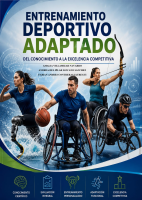
Entrenamiento deportivo adaptado: del conocimiento a la excelencia competitiva
Keywords:
1. Entrenamiento 2. Deporte 3. Pedagogía.Synopsis
El deporte adaptado ha dejado de ser concebido únicamente como un escenario de rehabilitación para consolidarse como una de las expresiones más significativas del desarrollo científico, la inclusión social y la excelencia competitiva. En las últimas décadas, el crecimiento del movimiento paralímpico, el fortalecimiento de la investigación interdisciplinaria y el avance de las tecnologías aplicadas al rendimiento han transformado profundamente la manera de comprender la preparación deportiva de los atletas con discapacidad. En este contexto, el entrenamiento deportivo adaptado representa un campo del conocimiento que integra las ciencias del deporte, la medicina, la fisiología, la biomecánica, la psicología, la pedagogía, la nutrición, la ingeniería y la innovación tecnológica con el propósito de optimizar el potencial humano desde una perspectiva científica y ética.
La presente obra constituye una contribución académica orientada a fortalecer la formación de estudiantes, entrenadores, investigadores, profesionales de las ciencias del deporte y responsables de las políticas públicas relacionadas con la actividad física y el deporte adaptado. Su contenido refleja una visión contemporánea del entrenamiento deportivo basada en la evidencia científica, reconociendo que el alto rendimiento no depende exclusivamente de las condiciones biológicas del atleta, sino de la calidad de los procesos de planificación, evaluación, seguimiento e intervención desarrollados por equipos interdisciplinarios comprometidos con la excelencia.
Uno de los principales méritos de este libro radica en su capacidad para integrar los fundamentos teóricos con las aplicaciones prácticas del entrenamiento deportivo adaptado. Cada capítulo desarrolla de manera rigurosa los principios científicos que sustentan la preparación física, técnica, táctica y psicológica de los deportistas, incorporando los avances más recientes en fisiología del ejercicio, biomecánica, neurociencias, análisis del rendimiento, inteligencia artificial y tecnologías emergentes. Esta perspectiva permite comprender que la excelencia deportiva es el resultado de procesos sistemáticos de planificación fundamentados en el conocimiento científico y no únicamente en la experiencia empírica.
Asimismo, esta obra trasciende el análisis estrictamente deportivo para abordar la dimensión humana, social y ética del deporte adaptado. El respeto por la diversidad funcional, la promoción de la igualdad de oportunidades, la defensa de los derechos de las personas con discapacidad y la construcción de sociedades más inclusivas constituyen principios transversales que enriquecen cada uno de los temas desarrollados. De esta manera, el entrenamiento deportivo adaptado se presenta como una herramienta de transformación social capaz de contribuir al bienestar individual, al fortalecimiento de la ciudadanía y al desarrollo sostenible.
Estamos convencidos de que este libro se convertirá en una referencia de consulta para universidades, centros de investigación, organizaciones deportivas y profesionales interesados en fortalecer sus competencias en este campo del conocimiento. Su rigor científico, claridad conceptual y orientación práctica representan un aporte significativo para la consolidación de una cultura deportiva basada en la evidencia, la innovación y la excelencia.
Invito al lector a recorrer estas páginas con una actitud crítica, reflexiva y abierta al aprendizaje permanente. Cada capítulo ofrece una oportunidad para comprender que el verdadero significado del deporte adaptado no reside únicamente en la obtención de resultados competitivos, sino en la capacidad de transformar vidas mediante el conocimiento, la inclusión y el reconocimiento del inmenso potencial humano.
Chapters
Downloads
References
American College of Sports Medicine. (2022). ACSM's guidelines for exercise testing and prescription (11th ed.). Wolters Kluwer.
American Psychological Association. (2020). Publication manual of the American Psychological Association (7th ed.). American Psychological Association.
Andersen, M. B. (2012). The psychology of elite athlete performance. Routledge.
Appelbaum, L. G., & Erickson, G. (2018). Sports vision training: A review of the state-of-the-art in digital training techniques. International Review of Sport and Exercise Psychology, 11(1), 160–189.
Araújo, D., Davids, K., & Renshaw, I. (2019). Cognition, emotion and action in sport: An ecological dynamics perspective. Routledge.
Australian Institute of Sport. (2023). High Performance Sport Strategy. https://www.ais.gov.au
Baca, A., & Kornfeind, P. (2020). Rapid feedback systems for elite sports training. Routledge.
Baker, J., Cobley, S., Schorer, J., & Wattie, N. (2020). Routledge handbook of talent identification and development in sport. Routledge.
Balagué, N., Torrents, C., Hristovski, R., & Kelso, J. A. S. (2020). Sport science integration: An evolutionary synthesis. European Journal of Sport Science, 20(6), 755–769.
Balyi, I., Way, R., & Higgs, C. (2013). Long-Term Athlete Development. Human Kinetics.
Bandura, A. (1997). Self-efficacy: The exercise of control. W. H. Freeman.
Bartlett, R. (2007). Introduction to sports biomechanics (2nd ed.). Routledge.
Bear, M. F., Connors, B. W., & Paradiso, M. A. (2020). Neuroscience: Exploring the Brain (4th ed.). Wolters Kluwer.
Beckman, E. M., Tweedy, S. M., & Connick, M. J. (2017). Classifying para-athletes for competition. Sports Medicine, 47(11), 2271–2277.
Behm, D. G. (2018). The science and physiology of strength training: Implications for sport performance and rehabilitation. Routledge.
Bompa, T. O., & Buzzichelli, C. (2019). Periodization: Theory and methodology of training (6th ed.). Human Kinetics.
Bouchard, C., Blair, S. N., & Haskell, W. L. (2012). Physical activity and health (2nd ed.). Human Kinetics.
Brittain, I. (2016). The Paralympic Games explained. Routledge.
Brooks, G. A., Fahey, T. D., & Baldwin, K. M. (2020). Exercise physiology: Human bioenergetics and its applications (5th ed.). McGraw-Hill Education.
Brüggemann, G.-P., Arampatzis, A., Emrich, F., & Potthast, W. (2008).
Biomechanics of double transtibial amputee sprinting using dedicated sprinting prostheses. Sports Technology, 1(4–5), 220–227.
Burke, L. M., Castell, L. M., Casa, D. J., Close, G. L., Costa, R. J. S., Desbrow, B.,
Halson, S. L., Lis, D. M., Melin, A. K., Peeling, P., Saunders, P. U., Slater, G. J., Sygo, J., & Witard, O. C. (2019). International Association of Athletics Federations consensus statement 2019: Nutrition for athletics. International Journal of Sport Nutrition and Exercise Metabolism, 29(2), 73–84.
Burke, L. M., Hawley, J. A., Wong, S. H. S., & Jeukendrup, A. E. (2018). Carbohydrates for training and competition. Journal of Sports Sciences, 36(7), 1–10.
Burke, L. M., Jeukendrup, A. E., Jones, A. M., & Mooses, M. (2021). Contemporary nutrition strategies to optimize performance in athletes. International Journal of Sport Nutrition and Exercise Metabolism, 31(5), 355–363.
Burkett, B. (2010). Technology in Paralympic sport: Performance enhancement or essential for performance? British Journal of Sports Medicine, 44(3), 215–220. https://doi.org/10.1136/bjsm.2009.068296
Carron, A. V., Brawley, L. R., & Eys, M. A. (2002). Group dynamics in sport. Fitness Information Technology.
Casa, D. J., Cheuvront, S. N., Galloway, S. D. R., & Shirreffs, S. M. (2019). Fluid needs for training, competition, and recovery in athletes. Journal of Athletic Training, 54(8), 805–817.
Claudino, J. G., Capanema, D. O., de Souza, T. V., Serrão, J. C., Machado Pereira, A. C., & Nassis, G. P. (2019). Current approaches to the use of artificial intelligence for injury risk assessment and performance prediction in team sports. Sports Medicine - Open, 5(1), 28.
Claudino, J. G., et al. (2019). Current approaches to the use of artificial intelligence for injury risk assessment and performance prediction in team sports. Sports Medicine, 49(10), 1523–1532.
Close, G. L., Kasper, A. M., & Morton, J. P. (2016). From paper to podium: The applied science of nutrition for elite athletes. Journal of Sports Sciences, 34(12), 1043–1052.
Comité Paralímpico Brasileño. (2023). Relatório Institucional. https://www.cpb.org.br
Cormie, P., McGuigan, M. R., & Newton, R. U. (2011). Developing maximal neuromuscular power: Part 1—Biological basis of maximal power production. Sports Medicine, 41(1), 17–38. https://doi.org/10.2165/11537690-000000000-00000
Côté, J., & Gilbert, W. (2009). An integrative definition of coaching effectiveness and expertise. International Journal of Sports Science & Coaching, 4(3), 307–323. https://doi.org/10.1260/1747-9541.4.3.307
Cotman, C. W., Berchtold, N. C., & Christie, L. A. (2007). Exercise builds brain health: Key roles of growth factor cascades and inflammation. Trends in Neurosciences, 30(9), 464–472.
Cramer, S. C., Sur, M., Dobkin, B. H., O'Brien, C., Sanger, T. D., Trojanowski, J. Q., ... Vinogradov, S. (2011). Harnessing neuroplasticity for clinical applications. Brain, 134(6), 1591–1609.
Cumming, J., & Williams, S. E. (2013). Introducing the revised applied model of deliberate imagery use. Journal of Imagery Research in Sport and Physical Activity, 8(1), 1–22.
Davids, K., Araújo, D., Shuttleworth, R., & Button, C. (2015). Acquiring skill in sport: A constraints-led perspective. En N. Hodges & M. Williams (Eds.), Skill acquisition in sport: Research, theory and practice (3rd ed., pp. 113–138). Routledge.
Dayan, E., & Cohen, L. G. (2011). Neuroplasticity subserving motor skill learning. Neuron, 72(3), 443–454.
De Bosscher, V., Shibli, S., Westerbeek, H., & Van Bottenburg, M. (2015). Successful Elite Sport Policies: An International Comparison of the Sports Policy Factors Leading to International Sporting Success (SPLISS 2.0). Meyer & Meyer Sport.
Debarnot, U., Sperduti, M., Di Rienzo, F., & Guillot, A. (2014). Experts' bodies, experts' minds: How physical and mental training shape the brain. Frontiers in Human Neuroscience, 8, 280.
Deci, E. L., & Ryan, R. M. (2000). The “what” and “why” of goal pursuits: Human needs and self-determination of behavior. Psychological Inquiry, 11(4), 227–268.
Dehghansai, N., Lemez, S., Wattie, N., & Baker, J. (2021). A systematic review of influences on development of athletes with disabilities. Adapted Physical Activity Quarterly, 38(2), 157–181. https://doi.org/10.1123/apaq.2020-0017
Dehghansai, N., Lemez, S., Wattie, N., & Baker, J. (2021). Training and development of Paralympic athletes: A systematic review. Journal of Sports Sciences, 39(21), 2439–2452. https://doi.org/10.1080/02640414.2021.1929738
DePauw, K. P., & Gavron, S. J. (2005). Disability sport (2nd ed.). Human Kinetics.
Derman, W., Schwellnus, M., Jordaan, E., Blauwet, C., Emery, C. A., Pit-Grosheide, P., & Webborn, N. (2018). The incidence and patterns of illness and injury during the Paralympic Games: A systematic review. British Journal of Sports Medicine, 52(1), 4–11. https://doi.org/10.1136/bjsports-2017-098512
Diamond, A. (2013). Executive functions. Annual Review of Psychology, 64, 135–168.
Dollar, A. M., & Herr, H. (2008). Lower extremity exoskeletons and active orthoses: Challenges and state of the art. IEEE Transactions on Robotics, 24(1), 144–158.
Enoka, R. M., & Duchateau, J. (2016). Translating fatigue to human performance. Medicine & Science in Sports & Exercise, 48(11), 2228–2238. https://doi.org/10.1249/MSS.0000000000000929
Fletcher, D., & Sarkar, M. (2012). A grounded theory of psychological resilience in Olympic champions. Psychology of Sport and Exercise, 13(5), 669–678.
Fransen, K., Haslam, S. A., Steffens, N. K., Vanbeselaere, N., De Cuyper, B., & Boen, F. (2015). Believing in “us”: Exploring leaders’ impact on team confidence. Journal of Applied Sport Psychology, 27(2), 202–218.
Frossard, L., et al. (2019). Biomechanics of Paralympic athletes. Sports Biomechanics.
Fullagar, H. H. K., Skorski, S., Duffield, R., Hammes, D., Coutts, A. J., & Meyer, T. (2015). Sleep and athletic performance: The effects of sleep loss on exercise performance. Sports Medicine, 45(2), 161–186.
Galli, N., & Vealey, R. S. (2008). “Bouncing back” from adversity: Athletes’ experiences of resilience. The Sport Psychologist, 22(3), 316–335.
Goosey-Tolfrey, V. L. (2010). Wheelchair sport: A complete guide for athletes, coaches and researchers. Human Kinetics.
Goosey-Tolfrey, V. L. (Ed.). (2017). Wheelchair sport: A complete guide for athletes, coaches and teachers (2nd ed.). Routledge.
Goosey-Tolfrey, V. L., & Crosland, J. (2010). Nutritional practices of athletes with a disability. International Journal of Sport Nutrition and Exercise Metabolism, 20(2), 134–145.
Goosey-Tolfrey, V. L., & Leicht, C. A. (2013). Field-based physiological testing of wheelchair athletes. Sports Medicine, 43(2), 77–91.
Greco, P. J., Memmert, D., & Morales, J. C. P. (2022). Cognition, creativity and decision making in sport. Routledge.
Groff, D. G., Lundberg, N. R., & Zabriskie, R. B. (2009). Influence of adapted sport on quality of life. Adapted Physical Activity Quarterly, 26(1), 39–58.
Gross, J. J. (2015). Emotion regulation: Current status and future prospects. Psychological Inquiry, 26(1), 1–26.
Gruzelier, J. H. (2014). EEG-neurofeedback for optimising performance. Neuroscience & Biobehavioral Reviews, 44, 124–141.
Gucciardi, D. F., Hanton, S., & Fleming, S. (2017). Are mental toughness and resilience the same? International Journal of Sport Psychology, 48(2), 73–96.
Gustafsson, H., DeFreese, J. D., & Madigan, D. J. (2017). Athlete burnout: Review and recommendations. Current Opinion in Psychology, 16, 109–113.
Guttmann, L. (1976). Textbook of sport for the disabled. HM+M Publishers.
Guyton, A. C., & Hall, J. E. (2021). Guyton and Hall textbook of medical physiology (14th ed.). Elsevier.
Haff, G. G., & Triplett, N. T. (Eds.). (2016). Essentials of strength training and conditioning (4th ed.). Human Kinetics.
Hafner, B. J., Morgan, S. J., Abrahamson, D. C., Amtmann, D., Gaunaurd, I. A., & Gailey, R. S. (2016). Characterizing mobility from the prosthetic limb user's perspective: Use of focus groups to guide development of the Prosthetic Limb Users Survey of Mobility. Prosthetics and Orthotics International, 40(5), 582–590.
Halson, S. L. (2014). Monitoring training load to understand fatigue in athletes. Sports Medicine, 44(Suppl. 2), S139–S147. https://doi.org/10.1007/s40279-014-0253-z
Hamill, J., Knutzen, K. M., & Derrick, T. R. (2021). Biomechanical basis of human movement (5th ed.). Wolters Kluwer.
Hanrahan, S. J., & Andersen, M. B. (2010). Routledge handbook of applied sport psychology. Routledge.
Hawley, J. A., Hargreaves, M., Joyner, M. J., & Zierath, J. R. (2014). Integrative biology of exercise. Cell, 159(4), 738–749. https://doi.org/10.1016/j.cell.2014.10.029
Henriksen, K., Schinke, R., McCann, S., & Moesch, K. (2017). Athlete mental health and well-being. International Journal of Sport and Exercise Psychology, 15(4), 1–15.
Hoptman, J. M., Dick, R., & Agel, J. (2007). Epidemiology of collegiate injuries for 15 sports: Summary and recommendations. Journal of Athletic Training, 42(2), 311–319.
Howard, M. C. (2019). A meta-analysis and systematic literature review of virtual reality rehabilitation programs. Computers in Human Behavior, 70, 317–327.
International Blind Sports Federation. (2024). IBSA Classification Rules and Procedures. IBSA.
International Federation for Athletes with Intellectual Impairments. (2023). Virtus Eligibility and Classification Rules. Virtus.
International Paralympic Committee. (2015). Athlete Classification Code. International Paralympic Committee.
International Paralympic Committee. (2023). Classification Code and International Standards. International Paralympic Committee.
International Paralympic Committee. (2023). IPC Athlete Development Framework. International Paralympic Committee.
International Paralympic Committee. (2025). IPC Classification Code and International Standards (Version 1 January 2025). International Paralympic Committee.
International Paralympic Committee. (2025). IPC handbook. International Paralympic Committee.
Issurin, V. B. (2016). Building the modern athlete: Scientific advancements and training innovations. Ultimate Athlete Concepts.
Jeukendrup, A. E. (2017). Periodized nutrition for athletes. Sports Medicine, 47(Suppl 1), 51–63.
Joyner, M. J., & Coyle, E. F. (2008). Endurance exercise performance: The physiology of champions. Journal of Physiology, 586(1), 35–44.
Kandel, E. R., Koester, J. D., Mack, S. H., & Siegelbaum, S. A. (2021). Principles of neural science (6th ed.). McGraw-Hill Education.
Kenney, W. L., Wilmore, J. H., & Costill, D. L. (2021). Physiology of sport and exercise (7th ed.). Human Kinetics.
Kenney, W. L., Wilmore, J. H., & Costill, D. L. (2022). Physiology of sport and exercise (8th ed.). Human Kinetics.
Knudson, D. (2021). Fundamentals of biomechanics (3rd ed.). Springer.
Kolb, B., & Gibb, R. (2014). The brain and behaviour: An introduction to behavioral neuroanatomy. Worth Publishers.
Kolb, B., & Gibb, R. (2015). The Brain's Plasticity and Behavior. Psychology Press.
Kraemer, W. J., & Ratamess, N. A. (2005). Hormonal responses and adaptations to resistance exercise and training. Sports Medicine, 35(4), 339–361. https://doi.org/10.2165/00007256-200535040-00004
Kreider, R. B., Stout, J. R., & Greenwood, M. (2017). Creatine supplementation: A review of current evidence. Journal of the International Society of Sports Nutrition, 14, 18.
Lane, A. M., Beedie, C. J., Jones, M. V., Uphill, M., & Devonport, T. J. (2012). Mood and emotions in sport. Journal of Sports Sciences, 30(6), 1–10.
Larson-Meyer, D. E. (2015). Vitamin D and athletes: Current perspectives and new challenges. Sports Medicine, 45(1), 1–14.
Latash, M. L. (2020). Motor Control and Learning. Academic Press.
Lees, A. (2002). Technique analysis in sports: A critical review. Journal of Sports Sciences, 20(10), 813–828.
Magill, R. A., & Anderson, D. (2021). Motor learning and control: Concepts and applications (12th ed.). McGraw-Hill Education.
Magill, R. A., & Anderson, D. I. (2017). Motor Learning and Control: Concepts and Applications (11th ed.). McGraw-Hill.
Mann, D. L., Runswick, O. R., & Allen, P. M. (2019). Visual search behaviours and anticipation in sport. International Review of Sport and Exercise Psychology, 12(1), 1–24. https://doi.org/10.1080/1750984X.2017.1411240
Martens, R., Vealey, R. S., & Burton, D. (1990). Competitive anxiety in sport. Human Kinetics.
Martin Ginis, K. A., van der Ploeg, H. P., Foster, C., Lai, B., McBride, C. B., Ng, K., Pratt, M., Shirazipour, C. H., Smith, B., Vásquez, P. M., & Heath, G. W. (2021). Participation of people living with disabilities in physical activity: A global perspective. The Lancet, 398(10298), 443–455. https://doi.org/10.1016/S0140-6736(21)01164-8
Martin, J. J. (2013). The psychology of disability sport and exercise. Oxford University Press.
Martin, J. J. (2015). Disability and sport: Adapted physical activity. Routledge.
Maughan, R. J., Burke, L. M., Dvorak, J., Larson-Meyer, D. E., Peeling, P., Phillips, S. M., Rawson, E. S., Walsh, N. P., Garthe, I., & Geyer, H. (2018). IOC consensus statement: Dietary supplements and the high-performance athlete. British Journal of Sports Medicine, 52(7), 439–455.
Mazzeo, F., Santamaria, S., & Iavarone, A. (2020). Nutrition education and adapted sports performance. Journal of Human Sport and Exercise, 15(4), 1–12.
McArdle, W. D., Katch, F. I., & Katch, V. L. (2023). Exercise physiology: Nutrition, energy, and human performance (10th ed.). Wolters Kluwer.
McCullagh, P., et al. (2020). Big data analytics in elite sport. Journal of Sports Analytics.
McDuff, D., Czerwinski, M., & Reiter, A. (2019). Artificial intelligence for personalized sports performance analysis. Nature Digital Medicine, 2, 1–3.
McGuigan, M. R. (2017). Monitoring training and performance in athletes. Human Kinetics.
Meeusen, R., Duclos, M., Foster, C., Fry, A., Gleeson, M., Nieman, D., ... Urhausen, A. (2013). Prevention, diagnosis and treatment of the overtraining syndrome. European Journal of Sport Science, 13(1), 1–24.
Miah, A. (2017). The ethics of sport technology. Routledge.
Molteni, F., et al. (2018). Exoskeleton and rehabilitation robotics: State of the art and future perspectives. European Journal of Physical and Rehabilitation Medicine.
Moran, A. (2016). The psychology of concentration in sport performers. Psychology Press.
Moritz, S. E., Feltz, D. L., Fahrbach, K. R., & Mack, D. E. (2000). The relation of self-efficacy measures to sport performance. Research Quarterly for Exercise and Sport, 71(3), 280–294.
Mountjoy, M., Sundgot-Borgen, J., Burke, L., Ackerman, K. E., Blauwet, C., Constantini, N., Lebrun, C., Lundy, B., Melin, A., Meyer, N., Sherman, R., Tenforde, A., Klungland Torstveit, M., & Budgett, R. (2018). IOC consensus statement on relative energy deficiency in sport (RED-S). British Journal of Sports Medicine, 52, 687–697.
Mujika, I. (Ed.). (2018). Recovery for performance in sport. Human Kinetics.
Nash, C., Sproule, J., & Horton, P. (2017). Sport coach education and development. Routledge.
Nieman, D. C., & Wentz, L. M. (2019). The compelling link between physical activity and the body's defense system. Journal of Sport and Health Science, 8(3), 201–217. https://doi.org/10.1016/j.jshs.2018.09.009
Noakes, T. (2012). Fatigue is a Brain-Derived Emotion that Regulates Exercise Behavior. Frontiers in Physiology, 3, 82.
Oliver, M. (1996). Understanding disability: From theory to practice. Macmillan.
Organización de las Naciones Unidas. (2006). Convención sobre los Derechos de las Personas con Discapacidad. Naciones Unidas.
Organización Mundial de la Salud. (2001). Clasificación Internacional del Funcionamiento, de la Discapacidad y de la Salud (CIF). OMS.
Organización Mundial de la Salud. (2022). Global Report on Health Equity for Persons with Disabilities. World Health Organization. https://www.who.int
Organización Mundial de la Salud. (2022). Global status report on physical activity 2022. OMS.
Park, J. L., & Fairweather, M. M. (2019). Neuroimaging in sport performance research: Current applications and future directions. Journal of Sport and Health Science, 8(5), 438–449.
Paulson, T. A. W., & Goosey-Tolfrey, V. L. (2017). Current perspectives on the physiology of wheelchair exercise. Sports Medicine, 47(1), 23–34. https://doi.org/10.1007/s40279-016-0584-8
Phillips, S. M., & Van Loon, L. J. C. (2011). Dietary protein for athletes: From requirements to optimum adaptation. Journal of Sports Sciences, 29(S1), S29–S38.
Phillips, S. M., & Winett, R. A. (2010). Uncomplicated resistance training and health-related outcomes: Evidence for a public health mandate. Current Sports Medicine Reports, 9(4), 208–213. https://doi.org/10.1249/JSR.0b013e3181e7da73
Pitsiladis, Y., et al. (2016). Athlome Project Consortium: A concerted effort to discover genomic and other “omic” markers of athletic performance. Nature Reviews Genetics.
Plews, D. J., et al. (2017). Training adaptation and heart rate variability in elite endurance athletes. Sports Medicine.
Posner, M. I., & Rothbart, M. K. (2007). Educating the Human Brain. American Psychological Association.
Powers, S. K., & Howley, E. T. (2021). Exercise physiology: Theory and application to fitness and performance (11th ed.). McGraw-Hill Education.
Purcell, L. K., Hingley, J., & Burgess, D. (2014). Nutrition considerations in athletes with disabilities. Clinical Journal of Sport Medicine, 24(2), 133–137.
Purcell, R., et al. (2019). Mental health of elite athletes. British Journal of Sports Medicine, 53(11), 667–699.
Purves, D., Augustine, G. J., Fitzpatrick, D., Hall, W. C., LaMantia, A. S., Mooney, R., Platt, M. L., & White, L. E. (2018). Neuroscience (6th ed.). Oxford University Press.
Raedeke, T. D., & Smith, A. L. (2001). Development and preliminary validation of an athlete burnout measure. Journal of Sport & Exercise Psychology, 23, 281–306.
Ratey, J. J., & Hagerman, E. (2013). Spark: The Revolutionary New Science of Exercise and the Brain. Little, Brown and Company.
Rees, T., et al. (2016). The Great British Medalists Project: A review of current knowledge on the development of the world's best sporting talent. Sports Medicine, 46(8), 1041–1058.
Rice, S. M., et al. (2016). Mental health and illness in elite athletes. British Journal of Sports Medicine, 50(3), 135–136.
Rizzo, A., & Koenig, S. (2017). Is clinical virtual reality ready for primetime? Neuropsychology, 31(8), 877–899.
Sanderson, D. J., & Sommer, H. J. (1985). Kinematic features of wheelchair propulsion. Journal of Biomechanics.
Schmidt, R. A., & Lee, T. D. (2019). Motor learning and performance: From principles to application (6th ed.). Human Kinetics.
Seidel-Marzi, O., & Ragert, P. (2020). Neuroplasticity and motor learning in sports. Neuroscience & Biobehavioral Reviews.
Seligman, M. E. P. (2011). Flourish: A visionary new understanding of happiness and well-being. Free Press.
Sherrill, C. (2004). Adapted physical activity, recreation and sport: Crossdisciplinary and lifespan (6th ed.). McGraw-Hill.
Shumway-Cook, A., & Woollacott, M. H. (2017). Motor control: Translating research into clinical practice (5th ed.). Wolters Kluwer.
Stellingwerff, T., Morton, J. P., & Burke, L. M. (2019). Nutrition for athletes: A practical guide. International Journal of Sport Nutrition and Exercise Metabolism, 29(1), 1–9.
Tang, Y. Y., Hölzel, B. K., & Posner, M. I. (2015). The neuroscience of mindfulness meditation. Nature Reviews Neuroscience, 16(4), 213–225.
Thomas, D. T., Erdman, K. A., & Burke, L. M. (2016). Position of the Academy of Nutrition and Dietetics, Dietitians of Canada, and the American College of Sports Medicine: Nutrition and athletic performance. Journal of the Academy of Nutrition and Dietetics, 116(3), 501–528. https://doi.org/10.1016/j.jand.2015.12.006
Tweedy, S. M., & Vanlandewijck, Y. C. (2011). International Paralympic Committee position stand—Background and scientific principles of classification in Paralympic sport. British Journal of Sports Medicine, 45(4), 259–269. https://doi.org/10.1136/bjsm.2009.065060
Tweedy, S. M., Beckman, E. M., & Connick, M. J. (2014). Paralympic classification: Conceptual basis, current methods and research update. PM&R, 6(8 Suppl.), S11–S17. https://doi.org/10.1016/j.pmrj.2014.05.013
UK Sport. (2023). High Performance Strategy. https://www.uksport.gov.uk
United Nations Educational, Scientific and Cultural Organization. (2015). Quality Physical Education Guidelines for Policy-Makers. UNESCO. https://unesdoc.unesco.org
United Nations. (2015). Transforming our world: The 2030 Agenda for Sustainable Development. United Nations.
United States Olympic & Paralympic Committee. (2023). Paralympic Sport Development Programs. https://www.usopc.org
Vallerand, R. J. (2015). The psychology of passion: A dualistic model. Oxford University Press.
Vanlandewijck, Y. C., & Thompson, W. R. (Eds.). (2016). Training and coaching the Paralympic athlete. Wiley-Blackwell.
Vealey, R. S. (2007). Mental skills training in sport. En G. Tenenbaum & R. Eklund (Eds.), Handbook of sport psychology (3rd ed.). Wiley.
Vestberg, T., Reinebo, G., Maurex, L., Ingvar, M., & Petrovic, P. (2017). Core executive functions are associated with success in young elite soccer players. PLoS ONE, 12(2), e0170845. https://doi.org/10.1371/journal.pone.0170845
Vestberg, T., Reinebo, G., Maurex, L., Ingvar, M., & Petrovic, P. (2017). Core executive functions are associated with success in young elite soccer players. PLoS ONE, 12(2), e0170845.
Walker, M. P. (2017). Why We Sleep: Unlocking the Power of Sleep and Dreams. Scribner.
Walker, M. P., & Stickgold, R. (2006). Sleep, memory, and plasticity. Annual Review of Psychology, 57, 139–166.
Weinberg, R. S., & Gould, D. (2023). Foundations of sport and exercise psychology (8th ed.). Human Kinetics.
Williams, A. M., & Ericsson, K. A. (2005). Perceptual-cognitive expertise in sport. International Journal of Sport and Exercise Psychology, 3(4), 317–331.
Wilmore, J. H., Costill, D. L., & Kenney, W. L. (2008). Physiology of sport and exercise (4th ed.). Human Kinetics.
Winnick, J. P., & Porretta, D. L. (2017). Adapted physical education and sport (6th ed.). Human Kinetics.
Winstein, C. J., Stein, J., Arena, R., Bates, B., Cherney, L. R., Cramer, S. C., et al. (2016). Guidelines for adult stroke rehabilitation and recovery. Stroke, 47(6), e98–e169.
Winter, D. A. (2009). Biomechanics and motor control of human movement (4th ed.). John Wiley & Sons.
World Anti-Doping Agency. (2021). World Anti-Doping Code 2021. WADA.
World Health Organization. (2001). International Classification of Functioning, Disability and Health (ICF). World Health Organization.
World Health Organization. (2022). Global report on health equity for persons with disabilities. World Health Organization.
World Para Athletics. (2023). World Para Athletics Classification Rules and Regulations. World Para Athletics.
World Para Athletics. (2024). World Para Athletics Rules and Regulations. World Para Athletics.
World Para Swimming. (2025). Classification Rules and Regulations. World Para Swimming.
Downloads
Published
Series
Categories
License

This work is licensed under a Creative Commons Attribution-NonCommercial-ShareAlike 4.0 International License.