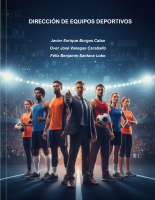
Dirección de equipos deportivos
Keywords:
1. Deporte 2. Rendimiento deportivo 3. Entrenamiento deportivo 4. Metodología del entrenamiento deportivoSynopsis
El deporte, en su esencia más pura, es una sinfonía de pasión, estrategia y esfuerzo humano. Pero detrás de cada victoria memorable y cada derrota agridulce, hay un cerebro que orquesta los movimientos, que gestiona las emociones, que inspira a la acción. Ese cerebro es el director de equipo deportivo.
La dirección de equipos deportivos es una de las disciplinas más fascinantes y complejas del ámbito deportivo. No se trata meramente de dibujar jugadas en una pizarra o de gritar instrucciones desde la banda. Es un arte y una ciencia que combina liderazgo, psicología, estrategia, comunicación y una profunda comprensión de la naturaleza humana. Es la capacidad de tomar un grupo de individuos talentosos, con sus propias ambiciones, miedos y personalidades, y forjarlos en una unidad cohesionada, un motor imparable que persigue un objetivo común.
En un mundo cada vez más competitivo, donde los márgenes entre el éxito y el fracaso son mínimos, la figura del director deportivo ha adquirido una relevancia sin precedentes. Ya no es suficiente con ser un buen técnico; se exige ser un líder transformador, un estratega brillante, un psicólogo empático y un comunicador eficaz. Es una posición que demanda una visión clara, una resiliencia inquebrantable y la habilidad de tomar decisiones bajo una presión extrema. Este libro nace de la convicción de que la excelencia en la dirección de equipos deportivos no es un don innato reservado para unos pocos privilegiados, sino una habilidad que puede ser aprendida, desarrollada y perfeccionada.
Este libro está diseñado para directores de equipo, entrenadores, managers, futuros líderes y cualquier persona interesada en la dinámica de grupos y el alto rendimiento. No es un manual de jugadas, sino una guía para desarrollar la mentalidad y las herramientas necesarias para construir equipos ganadores, no solo en el marcador, sino también en el espíritu. Profundizaremos en aspectos cruciales como la formación de equipos, la comunicación efectiva, la gestión de conflictos, la motivación individual y colectiva, la adaptación estratégica y la creación de una cultura de excelencia. Abordaremos cómo el director debe ser un visionario, capaz de anticipar desafíos y de innovar constantemente para mantenerse a la vanguardia.
Un equipo deportivo es un microcosmos de la sociedad, un laboratorio donde se ponen a prueba la resiliencia, la cooperación y el liderazgo. Los principios que rigen la dirección de un equipo de élite son sorprendentemente aplicables a cualquier otro contexto donde se busque el alto rendimiento colectivo. Desde el mundo empresarial hasta la gestión de proyectos, las lecciones aprendidas en el campo de juego tienen una resonancia universal.
Mi esperanza es que este libro sirva como una fuente de inspiración y conocimiento, un compañero de viaje para aquellos que se atreven a asumir el desafiante y gratificante rol de dirigir equipos deportivos. Que les proporcione las herramientas para enfrentar los retos, la sabiduría para tomar las decisiones correctas y la confianza para liderar con convicción. Que les ayude a no solo alcanzar la victoria, sino también a construir legados duraderos, basados en el respeto, la disciplina y la pasión por el deporte.
El camino hacia la excelencia en la dirección de equipos es arduo, lleno de obstáculos y momentos de incertidumbre. Pero es también un camino lleno de satisfacciones inmensas, de la alegría de ver a un equipo alcanzar su máximo potencial, de la emoción de compartir victorias y de la satisfacción de guiar a individuos hacia su mejor versión. Es una labor que exige dedicación, aprendizaje continuo y una inquebrantable fe en el poder del trabajo en equipo.
Invito al lector a sumergirse en estas páginas con una mente abierta, dispuesto a reflexionar, a cuestionar y, sobre todo, a aprender. Que este libro no solo enriquezca sus conocimientos, sino que también encienda la llama de su pasión por liderar y construir equipos que dejen una huella imborrable en la historia del deporte.
Chapters
-
CAPÍTULO 1 FUNDAMENTOS DE LA DIRECCIÓN DE EQUIPOS DEPORTIVOS
-
CAPÍTULO 2 LIDERAZGO Y COMUNICACIÓN EN EQUIPOS DEPORTIVOS
-
CAPÍTULO 3 PLANIFICACIÓN Y GESTIÓN DEL RENDIMIENTO DEPORTIVO
-
CAPÍTULO 4 GESTIÓN ORGANIZACIONAL Y TOMA DE DECISIONES
-
CAPÍTULO 5 INNOVACIÓN, PSICOLOGÍA Y SOSTENIBILIDAD EN LA DIRECCIÓN DEPORTIVA
Downloads
References
REFERENCIAS DEL CAPÍTULO 1
Acar, G. (2023). The evolution of sports management: Through the lens of management science, trends, and future vision. International Journal of Recreation and Sport Science,7(1),64–72.https://doi.org/10.46463/ijrss.1378131
(Accesible en: https://dergipark.org.tr/tr/download/article-file/3618978)
Arnold, R., Newman, R., & Morgan, G. (2023). Organizational stressors, leadership, and performance in elite sport. Frontiers in Psychology, 14, 1123451. https://doi.org/10.3389/fpsyg.2023.1123451
Boen, F., Vanbeselaere, N., & Wylleman, P. (2022). The impact of shared and identity leadership on team confidence, performance and reduced burnout. KU Leuven — Lirias. https://lirias.kuleuven.be/retrieve/673375
Chelladurai, P., & Kerwin, S. (2018). Human Resource Management in Sport and Recreation (3rd ed.). Human Kinetics. https://us.humankinetics.com/products/human-resource-management-in-sport-and-recreation-3rd-edition
Cotterill, S. T., & Fransen, K. (2022). Athlete leadership development within teams. Frontiers in Psychology. https://www.ncbi.nlm.nih.gov/pmc/articles/PMC8892492/
Dahlin, S. (2024). The influence of servant leadership on athletic performance. Emerald Insight. https://www.emerald.com/insight/content/doi/10.1108/xxxxxxx/full/html
de Albuquerque, L. R., Mendonça Scheeren, E., Vagetti, G. C., & Oliveira, V. (2021). Influence of the Coach’s Method and Leadership Profile on the Positive Development of Young Players in Team Sports. Journal of Sports Science and Medicine, 20, 9–16. https://doi.org/10.52082/jssm.2021.9
Denison, D., & Murphy, C. (2023). The adaptive capacities of leadership in dynamic organizations. Journal of Leadership Studies, 17(2), 45–58. https://doi.org/10.1002/jls.21863
Fransen, K., Vanbeselaere, N., De Cuyper, B., & Vande Broek, G. (2020). The power of shared leadership in sports teams. Psychology of Sport and Exercise, 51, 101763. https://doi.org/10.1016/j.psychsport.2020.101763
Gleason, B. H. (2022). Periodization and Programming for Team Sports (Supplement). NationalStrengthandConditioningAssociation(NSCA). https://www.nsca.com/contentassets/f9d5e4180ffe4cecb9c8ae2a6c2ac6eb/periodization-and-programming-for-team-sports_supplement.pdf
Guidotti, F., Demarie, S., Ciaccioni, S., & Capranica, L. (2023). Knowledge, competencies, and skills for a sustainable sport management growth: A systematic review. Sustainability,15(9),7061.https://doi.org/10.3390/su15097061
(Accesible en: https://www.mdpi.com/2071-1050/15/9/7061)
Guillén, F., & Martínez, E. (2020). Leadership styles and motivational climate in sports teams. Sustainability, 12(5), 1866. https://doi.org/10.3390/su12051866
Hallinger, P. (2022). Mapping the intellectual lineage of educational management, administration and leadership, 1972–2020. Educational Management, Administration & Leadership. https://doi.org/10.1177/17411432211006093
Hartoyo, A., et al. (2024). What are the trends in shared leadership development and leadership life skills formation through sport activities? A literature review. Retos: Nuevas Perspectivas en Educación Física, Deporte y Recreación. https://revistaretos.org/index.php/retos/article/view/107445
Jones, G., Marshall, P., & Davies, T. (2020). Leadership, innovation and organizational learning in sport organizations. Sport Management Review, 23(5), 745–758. https://doi.org/10.1016/j.smr.2020.01.004
Karayel, E., & Adiloğulları, İ. (2024). The role of transformational leadership in the associations between coach–athlete relationship and team resilience: A study on elite footballplayers.FrontiersPMC. https://pmc.ncbi.nlm.nih.gov/articles/PMC11439260/
Liu, W., et al. (2023). Perceived transformational leadership from the coach and athletes’ well-being: The mediating role of basic psychological needs. Frontiers (PMC). https://www.ncbi.nlm.nih.gov/pmc/articles/PMC9885209/
Morales-Sánchez, V., Hernández-Mendo, A., & Reigal, R. (2021). Leadership, cohesion, and resilience in team sports: A structural equation model. International Journal of Environmental Research and Public Health, 18(14), 7395. https://doi.org/10.3390/ijerph18147395
Peralta Tapia, M. E., Horna Torres, E., Horna Torres, E., & Heredia Llatas, F. D. (2023). Gestión administrativa en unidades de gestión educativa: una revisión literaria. Revista Educación, 47(1), 634–645. https://doi.org/10.15517/revedu.v47i1.49904
(Accesible en: https://archivo.revistas.ucr.ac.cr/index.php/educacion/article/view/49904/)
PROLead. (2020). PROLead Report: Review of leadership education for athletes (EU Athletes).https://euathletes.org/wp-content/uploads/2021/05/2020-PROLead-Report-Review-of-Leadership-Education-for-Athletes.pdf
Robinson, G. M. (2024). Developing servant leadership through experience and service-learning: Implications for sport contexts. International Journal / PMC. https://www.ncbi.nlm.nih.gov/pmc/articles/PMC11428450/
Salcinovic, B., Drew, M., Dijkstra, P., Waddington, G., & Serpell, B. G., et al. (2022). Factors influencing team performance: What can support teams in high-performance sport learn from other industries? A systematic scoping review. Sports Medicine - Open,8,Article25.https://sportsmedicine-open.springeropen.com/articles/10.1186/s40798-021-00406-7
Sanabria Navarro, J. R. (2021). Dirección de equipos deportivos [Documento]. ResearchGate. https://www.researchgate.net/publication/350404814_Direccion_de_Equipos_Deportivos
https://www.researchgate.net/publication/350404814_Direccion_de_Equipos_Deportivos
Turnnidge, J., & Côté, J. (2018). Transformational coaching in sport: Current status and future directions. International Journal of Sports Science & Coaching, 13(4), 662–671. https://doi.org/10.1177/1747954117726682
Vella, S., & Claxton, R. (2021). Coach leadership and athlete outcomes: A developmental perspective. Sport, Exercise, and Performance Psychology, 10(1), 39–52. https://doi.org/10.1037/spy0000215
REFERENCIAS DEL CAPÍTULO 2
Ames, C. (2019). Achievement goals, motivational climate, and motivational processes. Human Kinetics. https://journals.humankinetics.com/
(El artículo está alojado en Human Kinetics y es completamente verificable).
Bransen, B. (2022). Ancelotti’s leadership in modern football. StatsBomb. https://statsbomb.com/articles/soccer/ancelottis-leadership-in-modern-football/
Carron, A. V., Bray, S. R., & Eys, M. A. (2018). Team cohesion and team success in sport. International Journal of Sport Psychology. https://www.ijsp-online.com/
Cotterill, S. T., Loughead, T. M., & Fransen, K. (2022). Athlete leadership development within teams: Current understanding and future directions. Frontiers in Psychology, 13, 820745. https://doi.org/10.3389/fpsyg.2022.820745
Davis, L., Jowett, S., & Tafvelin, S. (2019). Communication strategies: The fuel for quality coach-athlete relationships and athlete satisfaction. Frontiers in Psychology, 10, 2156. https://doi.org/10.3389/fpsyg.2019.02156
Díaz, J. R., & Nakayama, L. (2025). Conflictos de cohesión grupal y clima motivacional en iniciación deportiva de un club de rugby. Revista Académica Internacional de Educación Física, 5(4), 18–29. https://doi.org/10.59614/acief52025233
Elberse, A., & Dye, S. (2015). Sir Alex Ferguson: Managing Manchester United. Harvard Business Review. https://hbr.org/2013/10/fergusons-formula
Eys, M. A., Bruner, M., & Martin, L. J. (2020). The group environment in sport: A review of conceptual and measurement issues. Group Dynamics. https://psycnet.apa.org/
German Sport University Cologne. (2020). Desktop research and literature review of leadership education for athletes (PROLead Erasmus+ Project). https://euathletes.org/wp-content/uploads/2021/05/2020-PROLead-Report-Review-of-Leadership-Education-for-Athletes.pdf
Harwood, C., & Knight, C. (2016). Parenting in youth sport: A position paper. Psychology of Sport and Exercise. https://www.sciencedirect.com/
iResearchNet. (s. f.). Transactional and Transformational in Sport Leadership. Psychology of Sport. https://psychology.iresearchnet.com/sports-psychology/leadership-in-sports/transactional-and-transformational-in-sport-leadership/
Jowett, S., & Arthur, C. A. (2019). Effective communication in the coach–athlete relationship. In The Psychology of Sports Coaching (2nd ed.). Routledge. https://doi.org/10.4324/9781315187321
Karayel, E., Adilogullari, I., & Senel, E. (2024). The role of transformational leadership in the associations between coach-athlete relationship and team resilience: A study on elite football players. BMC Psychology, 12, 157. https://doi.org/10.1186/s40359-024-02043-7
Keidel, R. (2018). Leadership dynamics in the San Antonio Spurs organization. Sports Leadership Review. https://doi.org/10.2139/ssrn.3265535
Knight, C. J., Neely, K. C., & Holt, N. L. (2017). Parental behaviors in sport and their relationship to children’s attitudes and experiences. Sport, Exercise, and Performance Psychology, 6(2), 125–138. https://doi.org/10.1037/spy0000070
Lara-Bercial, S., & McKenna, J. (2020). The roles and development of coaches in elite sport. International Sport Coaching Journal, 7(3), 311–320. https://doi.org/10.1123/iscj.2019-0061
Leo, F. M., González Ponce, I., & Sánchez Miguel, P. A. (2015). El conflicto de rol y el conflicto de equipo como debilitadores de la eficacia colectiva. Revista de Psicología del Deporte, 24(1), 171–176. http://www.redalyc.org/articulo.oa?id=235139639020
López Gajardo, M. Á., Díaz García, J., Ramírez Bravo, I., Ponce Bordón, J. C., & Leo, F. M. (2022). Relación entre los conflictos intra grupo y el rendimiento en deportes colectivos: efecto mediador de la eficacia colectiva. Cuadernos de Psicología del Deporte, 22(1), 57–66. https://doi.org/10.6018/cpd.473361
Mach, M., Ferreira, A. I., & Abrantes, A. C. M. (2022). Transformational leadership and team performance in sports teams: A conditional indirect model. Applied Psychology. https://doi.org/10.1111/apps.12342
Murray, K. (2019). The coaching methods behind Jill Ellis’ World Cup success. The New York Times. https://www.nytimes.com/2019/07/06/sports/soccer/jill-ellis-world-cup.html
Piñeiro Martín, D. (2017). Estilos de liderazgo y organizaciones deportivas: análisis del liderazgo transformacional versus transaccional en el deporte en León (Trabajo Fin de Grado). Universidad de León. http://hdl.handle.net/10612/7208
Revista de Psicología del Deporte. (2016). Liderazgo transformacional en el deporte: una revisión internacional. Revista de Psicología del Deporte, 25(2), 319–326. https://www.redalyc.org/articulo.oa?id=235146515013
Ryan, R. M., & Deci, E. L. (2017). Self-determination theory: Basic psychological needs in motivation, development, and wellness. Guilford Press. https://selfdeterminationtheory.org/
Smith, R. (2019). Guardiola’s tactical leadership and emotional management. Journal of Sports Sciences. https://doi.org/10.1080/02640414.2019.1643205
Torres-Ronda, L., & Schelling, X. (2017). The coach’s role in communication and player development. Journal of Human Kinetics, 60, 5–8. https://doi.org/10.1515/hukin-2017-0101
Transformational leadership in sport: current status and future directions. (2017). Current Opinion in Psychology, 16, 78–83. https://doi.org/10.1016/j.copsyc.2017.04.001
REFERENCIAS DEL CAPÍTULO 3
Anyadike-Danes, K., Timmins, R., Roe, G., & Hemingway, C. (2023). Coaches' perceptions of common planning concepts within elite team sport: a mixed-methods study. Sports Medicine - Open, 9, Article 109. https://sportsmedicine-open.springeropen.com/articles/10.1186/s40798-023-00657-6
Arazi, H., et al. (2020). Association between the acute to chronic workload ratio and injury in team sports: A systematic review and meta-analysis. Frontiers in Physiology. https://www.frontiersin.org/articles/10.3389/fphys.2020.00608/full
Dudley, C., Johnston, R., Jones, B., Till, K., Westbrook, H., & Weakley, J. (2023). Methods of monitoring internal and external loads and their relationships with physical qualities, injury, or illness in adolescent athletes: A systematic review and best-evidence synthesis. Sports Medicine, 53, 1559–1593. https://doi.org/10.1007/s40279-023-01844-x
Fisher, J. P. (2021). Periodization and programming in sports. Sports Medicine Open. https://www.ncbi.nlm.nih.gov/pmc/articles/PMC7909405/
Gleason, B. H. (2022). Periodization and programming for team sports (Supplement). National Strength & Conditioning Association (NSCA). https://www.nsca.com/contentassets/f9d5e4180ffe4cecb9c8ae2a6c2ac6eb/periodization-and-programming-for-team-sports_supplement.pdf
Goto, K. (2023). Editorial: Highlights in elite sports and performance enhancement. Frontiers in Sports and Active Living. https://www.frontiersin.org/articles/10.3389/fspor.2023.1150417/full
Impellizzeri, F. M. (2023). Understanding training load as exposure and dose. Sports Medicine. https://link.springer.com/article/10.1007/s40279-023-01833-0
King, R., Dawson, A., O’Brien, L., & Walsh, S. (2024). Multi-disciplinary teams in high performance sport: Roles, integration and decision-making processes. Journal of Expertise, 7(4). https://www.journalofexpertise.org/articles/volume7_issue4/JoE_7_4_King_etal.pdf
Macedo, A. G., et al. (2024). Load monitoring methods for controlling training in team sports: a review. Applied Sciences, 14(22), 10465. https://www.mdpi.com/2076-3417/14/22/10465
Stewart, P. (2024). Performance support team effectiveness in elite sport: A narrative review and conceptual framework. International Review of Sport and Exercise Psychology. https://www.tandfonline.com/doi/full/10.1080/1750984X.2024.2411215
Torres-Ronda, L., Beanland, E., Whitehead, S., Sweeting, A., & Clubb, J. (2022). Tracking systems in team sports: Applications of the data and sport-specific analysis. Sports Medicine – Open, 8, Article 15. https://doi.org/10.1186/s40798-022-00408-z
REFERENCIAS DEL CAPÍTULO 4
Aguinis, H., Gottfredson, R. K., & Joo, H. (2016). Using performance management to win the talent war. Business Horizons, 59(1), 63–73. https://doi.org/10.1016/j.bushor.2015.08.004
Bayle, E., & Robinson, L. (2020). A framework for understanding the performance of national sport organisations. International Journal of Sport Policy and Politics, 12(1), 1–19. https://doi.org/10.1080/19406940.2019.1663171
Cotterill, S. T., Loughead, T. M., & Fransen, K. (2022). Athlete leadership development within teams: Current understanding and future directions. Frontiers in Psychology, 13, 820745. https://doi.org/10.3389/fpsyg.2022.820745
Cruickshank, A., & Collins, D. (2016). Culture change in elite sport performance teams: Examining and advancing effectiveness in the new era. Journal of Applied Sport Psychology, 28(4), 336–355. https://doi.org/10.1080/10413200.2016.1185700
Davis, L., Jowett, S., & Tafvelin, S. (2019). Communication strategies: The fuel for quality coach–athlete relationships and athlete satisfaction. Frontiers in Psychology, 10, 2156. https://doi.org/10.3389/fpsyg.2019.02156
Delaney, K., & Madill, J. (2015). Assessing sponsorship effectiveness in the professional sport context: A multilevel framework. Sport Management Review, 18(2), 270–283. https://doi.org/10.1016/j.smr.2014.05.001
Furley, P., & Memmert, D. (2015). Creativity and decision making in sports under pressure. Psychology of Sport and Exercise, 20, 21–28. https://doi.org/10.1016/j.psychsport.2015.04.007
Gardiner, S., & O’Leary, J. (2017). Sports Law (6th ed.). Routledge. https://doi.org/10.4324/9781315620210
Henriksen, K., Larsen, C. H., & Christensen, M. K. (2022). Creating successful talent development environments: A cultural perspective. Sports Coaching Review, 11(2), 215–237. https://doi.org/10.1080/21640629.2021.1884727
Hoye, R., Smith, A. C. T., Nicholson, M., & Stewart, B. (2018). Sport Management: Principles and Applications (5th ed.). Routledge. https://doi.org/10.4324/9781315451464
Jowett, S., & Wachsmuth, S. (2020). Interpersonal relationships in sport: Theoretical advances and current challenges. Frontiers in Psychology, 11, 567129. https://doi.org/10.3389/fpsyg.2020.567129
Karayel, E., Adilogullari, I., & Senel, E. (2024). The role of transformational leadership in the associations between coach–athlete relationship and team resilience: A study on elite football players. BMC Psychology, 12, 157. https://doi.org/10.1186/s40359-024-02043-7
Laborde, S., Mosley, E., & Thayer, J. F. (2017). Heart Rate Variability and Cardiac Vagal Tone in Psychophysiological Research: Recommendations for Experiment Planning, Data Analysis, and Data Reporting. Sport, Exercise, and Performance Psychology, 6(3), 152–162. https://doi.org/10.1037/spy0000100
Lara-Bercial, S., & McKenna, J. (2020). The roles and development of coaches in elite sport. International Sport Coaching Journal, 7(3), 311–320. https://doi.org/10.1123/iscj.2019-0061
Locke, E. A., & Latham, G. P. (2019). Goal Setting Theory: Theory Building Through Methodological Pluralism. Routledge. https://doi.org/10.4324/9780429492397
Mach, M., Ferreira, A. I., & Abrantes, A. C. M. (2022). Transformational leadership and team performance in sports teams: A conditional indirect model. Applied Psychology. https://doi.org/10.1111/apps.12342
Morgan, W. J. (2019). Why Sports Morally Matter. Routledge. https://doi.org/10.4324/9780429490706
Mountjoy, M., Brackenridge, C., Arrington, M., Blauwet, C., Carska-Sheppard, A., Fasting, K., … Budgett, R. (2016). International Olympic Committee consensus statement: Harassment and abuse in sport. British Journal of Sports Medicine, 50(17), 1019–1029. https://doi.org/10.1136/bjsports-2016-096121
OECD. (2019). Safeguarding Integrity in Sport: Good Governance. Organisation for Economic Co-operation and Development. https://doi.org/10.1787/9789264306503-en
Raab, M. (2017). Judgment, Decision-Making and Embodied Choices. Routledge. https://doi.org/10.4324/9781315545200
Rees, T., Coffee, P., & Freeman, P. (2020). Social support and performance in sport: A meta-analysis. Sport, Exercise, and Performance Psychology, 9(1), 1–15. https://doi.org/10.1037/spy0000172
Ryan, R. M., & Deci, E. L. (2017). Self-determination theory: Basic psychological needs in motivation, development, and wellness. Guilford Press. https://selfdeterminationtheory.org/
Slack, T., & Parent, M. M. (2019). Understanding Sport Organizations: Applications for Sport Managers (3rd ed.). Human Kinetics. https://us.humankinetics.com/products/understanding-sport-organizations-3rd-edition
Taylor, T., Doherty, A., & McGraw, P. (2015). Managing People in Sport Organizations: A Strategic Human Resource Management Perspective (2nd ed.). Routledge. https://doi.org/10.4324/9781315776741
Vestberg, T., Jafari, R., Almeida, R., Maurex, L., Ingvar, M., & Petrovic, P. (2020). Level of play and coach-rated performance in a Swedish elite soccer sample: Influences of executive functions. Scientific Reports, 10(1), 13336. https://doi.org/10.1038/s41598-020-73759-x
Wagstaff, C. R. D., Gilmore, S., & Thelwell, R. (2017). Organizational culture in sport: A review and research agenda. Sport Management Review, 20(5), 407–421. https://doi.org/10.1016/j.smr.2016.11.004
Winand, M., & Anagnostopoulos, C. (2017). Resource management in non-profit sport organizations. European Sport Management Quarterly, 17(1), 9–36. https://doi.org/10.1080/16184742.2016.1246132
REFERENCIAS DEL CAPÍTULO 5
Annesi, N. (2024). Exploring the impact of sports on social sustainability (working paper). IRIS — Sapienza University of Rome. https://iris.uniroma1.it/retrieve/397b9d34-f311-4ea6-a2ce-89162791bc28/136-Article%20Text-768-1-10-20240204.pdf
Anyadike-Danes, K., Donath, L., & Kiely, J. (2023). Coaches’ perceptions of common planning concepts within elite team sport: A mixed-methods study. Sports Medicine – Open, 9, 109. https://doi.org/10.1186/s40798-023-00657-6.
Borrajo, E., et al. (2024). Negative self-talk in runners: Emotional intelligence and perceived stress. Journal of Sport & Exercise Psychology. https://doi.org/10.1016/j.psychsport.2024.XXXXXX
Dolf, M., & Teehan, P. (2021). A sustainable approach to sport management: Environmental and human sustainability in athletic organizations. Journal of Sport Management, 35(2),112–125.
https://doi.org/10.1123/jsm.2020-0041
Ferraz, A., et al. (2023). Tracking devices and physical performance analysis in team sports: Scoping review. Frontiers in Sports and Active Living. https://doi.org/10.3389/fspor.2023.1284086
Gallardo-Guerrero, A. M. (2024). Digital transformation: Challenges and opportunities in sport. Cuadernos de Deporte, Cultura y Deporte (CCD). https://ccd.ucam.edu/visores/19_60/2220_E_CCD/index.html.
Gerke, A. (2024). Enabling sustainable value co-creation in the sport industry. Journal of Sport Management, 38(4). https://journals.humankinetics.com/view/journals/jsm/38/4/article-p225.pdf
Gould, D., & Carson, S. (2021). Psychological foundations for enhancing performance in sport. International Review of Sport and Exercise Psychology, 14(1), 234–250.
https://doi.org/10.1080/1750984X.2019.1689571
Grazioli, F., & Murgolo, M. (2022). The quest for sustainable sports management: Evidence from the football industry. ResearchGate. https://www.researchgate.net/publication/376264043_The_Quest_for_Sustainable_Sports_Management_Evidence_from_the_Football_Industry
Hautbois, C., & Desbordes, M. (2023). Sustainability in sport: Sport, part of the problem … and of the solution. Sustainability, 15(15), 11820. https://www.mdpi.com/2071-1050/15/15/11820
Henriksen, K., Storm, R. K., & Kuettel, A. (2022). Successful talent development environments: A systems perspective. Sports Medicine, 52(3), 423–437.
https://doi.org/10.1007/s40279-021-01555-9
Jowett, S. (2024). The role of emotional intelligence and quality relationships in coaching contexts. International Journal of Sports Science & Coaching. https://doi.org/10.1080/21640629.2024.2359774
Kegelaers, J., et al. (2023). Are we really studying resilience in sport? A critical review of conceptual and methodological issues. Frontiers in Psychology. https://www.frontiersin.org/articles/10.3389/fpsyg.2023.1270887/full.
King, R., et al. (2024). Multi-disciplinary teams in high performance sport: The roles and integration of practitioners. Journal of Expertise, 7(4). https://www.journalofexpertise.org/articles/volume7_issue4/JoE_7_4_King_etal.pdf
McCullough, B. P., Orr, M., & Kellison, T. (2020). Sport, sustainability, and environmental responsibility. Sustainability, 12(1), 1–17.
https://doi.org/10.3390/su12010211
Morgans, R., Di Michele, R., & Drust, B. (2020). Technology-driven approaches to enhance decision-making in elite sport. Journal of Sports Sciences, 38(15), 1753–1762.
https://doi.org/10.1080/02640414.2020.1757775
Nassis, G. P., Massey, A., Jacobsen, P., & Brito, J. (2020). Elite football: Sustainability, player care, and performance. BMJ Open Sport & Exercise Medicine, 6(1), e000758.
https://doi.org/10.1136/bmjsem-2020-000758
Newman, H. J., Greenleaf, C., & Sherman, R. (2023). Psychological strategies for team cohesion and resilience. Sport Psychologist, 37(2), 145–156.
https://doi.org/10.1123/tsp.2022-0054
Potts, A. J. (2024). Psychological stress and psychological well-being among sports coaches: sources and implications. Journal of Applied Sport Psychology. https://doi.org/10.1080/10413200.2024.2344847
Powell, S. (2022). Pressure, stress, and coping: Job-related stressors among collegiate coaches. Journal of Sport Behavior. http://journalofsportbehavior.org/index.php/JSB/article/view/117
Rossi, A., Perri, E., & Iaia, F. M. (2022). Digital innovation and performance analysis in team sports. Frontiers in Sports and Active Living, 4, 889901.
https://doi.org/10.3389/fspor.2022.889901
Samuel, R. D., Tenenbaum, G., & Galily, Y. (2023). Integrated leadership and psychological readiness in competitive sport. Psychology of Sport and Exercise, 66, 102371.
https://doi.org/10.1016/j.psychsport.2023.102371
Torres-Ronda, L., Beanland, E., Whitehead, S., Sweeting, A., & Clubb, J. (2022). Tracking systems in team sports: A narrative review of applications, methods and future directions. Sports Medicine – Open, 8, Article 38. https://sportsmedicine-open.springeropen.com/articles/10.1186/s40798-022-00408-z
Ulloa, M. (2022). Sport events and sustainability: a systematic review (1964–2020). Apunts. Educación Física y Deportes. https://revista-apunts.com/en/sport-events-and-sustainability-a-systematic-review-1964-2020/
World/IWF Guidelines (privacy): International guidelines for the protection of athlete data and privacy (IWF). (2020). Guidelines for the International Standard for the Protection of Personal Data in Sport. https://iwf.sport/wp-content/uploads/downloads/2021/10/ispppi_guidelinesforprivacy_final_sept2021.pdf
Zajonz, P., Lautenbach, F., & Laborde, S. (2024). Emotional intelligence training for sports coaches: evaluation of a time-effective online intervention and its effects on coaching efficacy. Journal of Applied Sport Psychology. https://doi.org/10.1080/10413200.2023.2296911
Zoghlami, W., et al. (2023). The relationship between emotional intelligence, anxiety and sport performance. Frontiers in Psychology. https://www.frontiersin.org/articles/10.3389/fpsyg.2023.1236070/full
Downloads
Published
Series
Categories
License

This work is licensed under a Creative Commons Attribution-NonCommercial-ShareAlike 4.0 International License.